This piece was warmly received when Ali Hall republished it on her Substack, Life Without Children. If you’d like to read the comments and join the conversation there, you can find it here.
A little while ago I came up with the word ‘mumspreading’. A play on ‘manspreading’: that phenomenon whereby men will sit with their knees apart on public transport, legs colonising the space in front of their own seats and those either side of them too, whether or not there is someone sitting there.
Mumspreading, as I use it, describes something analogous: the ways in which some mums can take up physical, conversational, emotional space without much awareness of the impact on those around them.
This is, ultimately, a post about the invisible grief of childlessness, and what it means to take up space in a world not designed with you in mind.
I am taking a risk here. In our world today it seems to suit those in power to foment division between people, creating factions and fanning the flames of righteous indignation and outrage. Turning us against each other as a distraction from the grand-scale outrages being enacted on the national and global stages. This is not intended as a hot take. I have zero interest in pitting mothers against non-mothers, the childless against the child-free (another of those binaries which can miss the nuance). This is not all mothers, or even most mothers. I am writing about a particular pattern that many childless people will recognise. I am writing in the hope that some readers will feel seen and validated, and others will gain some extra insight into an experience which is not their own.
Sometimes the marginalised groups need to be a bit louder, a bit bolder, to be heard.
Recently my friend – the talented animation writer/director and illustrator Justyna Green – created an image inspired by the term. The illustration showed two women on a park bench, one of them rifling in her bag whilst her children pulled at her neighbour’s hair and blew a trumpet and her dog had a poo by the path. A flurry of comments, a lot of recognition. Some pained and hurt responses too.
It feels important to me to contribute to the discussion in my own medium – words – to say what this word means to me, and why I think it matters to talk about it.
Yes, there is physical mumspreading. The school pickup chaos: cars parked on the verge, a stream of mother-buggy-child-dog configurations. Having to step into the road, or stand and wait until the tide passes. Family groups so absorbed in the moment that they don’t notice or acknowledge those who make way for them.
Because children are gloriously chaotic creatures and managing them in public spaces can take everything you have.
I know this. I hold it. Women have fought long and hard for the right to take space, be visible, proud, fabulous, in public life. That fight continues.
And yet it can leave those who step aside feeling, for that moment, like a person who doesn’t quite exist.
That feeling – the invisibility – is what I actually want to talk about.
I write from my own experience and from what I hear in my work and ‘on the circuit’. I know that experiences of childlessness vary enormously. For some, the grief remains lifelong and central; for others it shifts, softens, or becomes one thread among many in a full and meaningful life. I am not speaking for everyone.
The mumspreading that cuts deepest
“It’s not only women with children who need support. For society to flourish, we all need a village, which means we all need to be villagers.” — Ali Hall, Life Without Children (Substack)
The physical sidelining I can navigate. The conversational, emotional and relational sidelinings: those are harder.
The assumption that we know when the school holidays are. That we’re not working over half term. The group conversations that turn to schools and events in their children’s lives. The assumption that our delight at their pregnancy announcement will be as unalloyed as theirs. Even, sometimes, open disappointment or feedback that we’ve fallen short: not performed enough enthusiasm to satisfy their expectations.
To be clear: I love children. And that, really, is the point.
The most painful expression of this – and I know I am not alone in this – is the quiet exclusion. The conversations we can’t join in with. The events we’re not invited to. The school mums network. The fun times when parents get to be ‘off-duty’, bonding and making memories together. The question “do you have children?” from new acquaintances, a ‘no’ followed by a subtle recalibration, maybe a pivot back to other people and the safer ground of shared parenting experience. The interest not shown, the questions not asked. These can accumulate on top of a grief that is already weighing heavily.
On grief as initiation
Grief is one of the great initiations.
I have a deep interest in ideas of transformation, initiatory experiences, rites of passage. Clarissa Pinkola Estés, Octavia Butler, Ursula LeGuin, Angela Carter, Sharon Blackie… writers and storytellers immemorial have spoken about initiatory experiences: the ordeals that crack us open and remake us.
Whether it comes through infertility, pregnancy loss or illness, through gender or sexual identity, because of a decision made, or life circumstances, a relationship that didn’t survive the trying, or the stars just not aligning, the grief of involuntary childlessness is a profound initiatory experience. It asks enormous things of the people who live it. It changes them. At great cost, it teaches them about love and longing and loss and the extraordinary resilience of the human spirit.
On matrescence, and other initiations
There is a narrative – well-camouflaged but too often present nonetheless – that those who haven’t become a mother don’t truly understand what it is to love. The idea that we haven’t really grown up, haven’t really been tested – is not just wrong. It is a particularly cruel kind of erasure.
Matrescence – the transformation that occurs as people become mothers – deserves to be named and explored and honoured. It, too, is an initiation. It changes people in ways that are almost impossible to articulate to those who haven’t experienced it. I have not been through that initiation; and I have a profound respect and awe for the mystery of it.
And it is not the only initiation that counts.
I love Martin Shaw’s wry comment [I paraphrase]: “initiatory experiences, that nowadays we often call ‘bad luck’.” The ‘bad luck’ of not becoming a parent when it has been a deeply-held wish is a true threshold experience. Whatever path we take to arrive at non-parenthood, there are ordeals, and tests. We face monsters, and gain allies along the way.
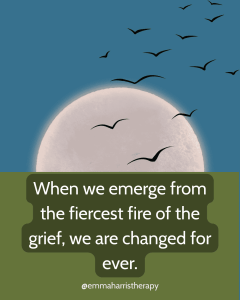
When we emerge from the fiercest fire of the grief, we are changed for ever. We develop edges; in the language of Internal Family Systems, new protectors come into being. We may become hypervigilant, scanning for – and guarding against – the moments that can poke our wounds, make us wince. And there are many. We gather our lists of safe people, alongside whom we can expand and take space. We look for our own communities – and, I hope, we find them.
Finding our village
“Like a wild animal, the soul is tough, resilient, resourceful, savvy and self-sufficient: it knows how to survive in hard places… Yet despite its toughness, the soul is also shy… A circle of trust is a group of people who know how to sit quietly ‘in the woods’ with each other and wait for the shy soul to show up. The relationships in such a group are not pushy but patient; they are not confrontational but compassionate; they are filled not with expectations and demands but with abiding faith in the reality of the inner teacher and in each person’s capacity to learn from it.” — Parker Palmer, A Hidden Wholeness
Here, again, is the village. Showing up, supporting, ready to witness each other.
Our job, then, is to grieve and to integrate the knowledge that we will never ourselves be a mum, never get to inhabit that hallowed space in the world. It is for us to identify a new shape to take, an alternative space to inhabit. In a society which defaults to the assumption that women will be mothers, we need to work hard to hold that space, to let others know that it is here, we are here, and we bring gifts too.
Fertility privilege
I first heard the term “fertility privilege” from Elizabeth Day on the podcast Best Friend Therapy, as she spoke with characteristic honesty about her own experience of infertility and miscarriage. Day uses it to describe the societal advantages held by those who can conceive naturally and easily, and the ways in which assuming pregnancy is a given blinds people to the emotional and physical trauma of infertility.
It is not an uncomplicated term. Writing in The Guardian, Rhiannon Lucy Cosslett acknowledged its value whilst also noting that fertility is neither fixed nor straightforwardly desirable: that it shifts over time, intersecting with class, race, and circumstance; and that pregnancy and parenthood bring their own profound vulnerabilities.
I am not saying that being a mum is easy. The challenges are well-documented elsewhere. Here I am writing about the experience of non-mums.
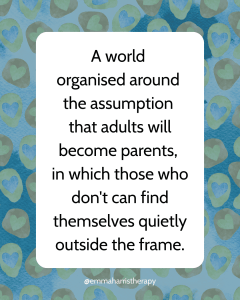
If privilege describes the advantages that accrue to people based on characteristics they didn’t choose, then fertility privilege points to something structural: a world organised around the assumption that adults will become parents, in which those who don’t can find themselves quietly outside the frame.
No one earns their fertility
No one chooses whether or not they can conceive, or carry a baby to term. No one earns their fertility. And the impulse behind what I am calling mumspreading is often simply the natural expansion of an identity that has room to expand, into spaces that have been shaped to receive it.
In a society that normalises parenthood as the default adult experience, these moments of unacknowledged privilege can be cumulative and costly. These are what researchers and activists call microaggressions: small in isolation, cumulative in impact, and almost impossible to name in the moment without seeming oversensitive.
A name of one’s own
The English-speaking childless community doesn’t yet have an identity that names what we are rather than what we lack. Childless: defined by absence. Childfree: works for some; for others it doesn’t sufficiently honour the grief. Non-parent: another negation.
It has been over a decade since Jody Day began her groundbreaking advocacy for childless women – her TEDx talk, her book Living the Life Unexpected, her founding of Gateway Women. Each year during World Childless Week and at the wonderful gathering in Chester (UK), Storyhouse Childless, the community acknowledges that the right word has still not emerged.
We are still left to define ourselves in opposition to the mums, instead of alongside them: women, humans, fellow beings on this earth. There is an oppression in this sociolinguistic binary, for all of us.
I am writing from within a particular cultural context – white, Western, British – and I know that the experience of childlessness, and the weight it carries, will look and feel different across cultures, communities, and generations.
Language hasn’t caught up yet
Not having a word doesn’t mean not having an experience. It doesn’t mean the losses are less real, or less profound, or less deserving of acknowledgment. It just means language hasn’t quite caught up yet.
In the meantime, those of us living without the children we longed for are navigating a landscape that wasn’t designed with us in mind. Seeking our own language, making our own rituals, our own ways of honouring what we carry.
What I hope for
I have no wish for anyone to make themselves smaller.
I am asking for a widening of awareness. Curiosity. Compassion. A pause. A question. For each of us, whatever form our privilege may take, to consider whether the person we are talking to might be carrying a grief that we can’t see.
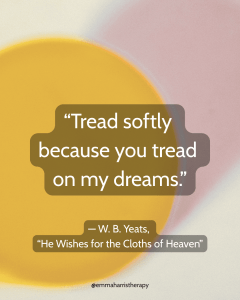
“Tread softly because you tread on my dreams.” — W. B. Yeats, “He Wishes for the Cloths of Heaven”
The wish implicit in the word ‘mumspreading’ is simple. To expand the circle of awareness. To allow space, as we move through the world, for the people sitting in the seats either side.
To perhaps, occasionally, ask how it is for them to be sitting there.
FAQs
What is disenfranchised grief?
Disenfranchised grief is grief that isn’t openly acknowledged, publicly mourned, or socially supported: losses that others may not recognise as significant, or may not recognise as losses at all.
One of its most painful expressions is the assumption that someone has simply “got over it.”
The grief of involuntary childlessness is a profound example. Because childlessness is a lifelong reality, the grief tends to be lifelong too. It may become less acute, but it can be reactivated – by a pregnancy announcement, a conversation that turns to schools and children, the question “do you have kids?” from a new acquaintance, or simply the quiet sense of being on the margins of a society organised around parenthood.
What is a microaggression?
The term ‘microaggression’ was coined by psychiatrist Chester Pierce in the 1970s to describe the subtle, often unconscious verbal, behavioural or environmental slights or insults experienced by Black people in white-dominated spaces and institutions.
It has since been used more widely to describe the moments in which members of other marginalised groups are made to feel invisible, othered, or less than – often in ways that are hard to name without being dismissed as “oversensitive”. For those navigating involuntary childlessness in a pronatalist society, these moments can be a daily reality.
What is pronatalism?
Pronatalism is the cultural assumption that having children is the natural, default path for adults, and that parenthood is the primary marker of a complete, meaningful life. It shows up in policy, in language, in social rituals, and in everyday conversation. It is so embedded in many societies that it often goes unnoticed by those it centres. For those who are not parents whether by choice or circumstance – pronatalism can be a constant, quiet presence: a reminder that the world was not entirely designed with them in mind.
A note on this piece: I write from my own perspective and lived experience. My intention is not to generalise, but to share how things come together for me – and to invite reflection rather than offer conclusions.
About the author
Emma Harris is a BACP-accredited psychotherapist, Level 3 trained Internal Family Systems therapist, EMDR practitioner and clinical supervisor. She works online with adults across the UK. Clients are often navigating complex grief, childlessness by circumstance, neurodivergence, life transitions and identity shifts.
Her work is grounded in compassion, curiosity and respect for the many different ways a life can unfold. She is particularly interested in experiences that are often misunderstood, minimised or pushed to the margins.
If this piece resonated with you, or you know someone who might feel seen by it, I’d love you to share my words with them.
Childlessness and non-parenthood resources
World Childless Week takes place online each year, with free events, writing and community contributions. In 2026, World Childless Week will be 14-20 September.
Storyhouse Childless takes place each year at Storyhouse arts centre in Chester. Storyhouse Childless 2026 will be 25-27 September.
If you are navigating childlessness, childlessness by circumstance, or an evolving identity as a non-parent, I offer online therapy for adults in this position.
We use cookies to help this site run smoothly and to understand how it's used. You're welcome to accept, decline, or choose what to allow below.
Functional
Always active
These cookies are essential for the site to work properly, for things like page navigation, contact forms and maps. The site won't function fully without them.
Preferences
The technical storage or access is necessary for the legitimate purpose of storing preferences that are not requested by the subscriber or user.
Statistics
The technical storage or access that is used exclusively for statistical purposes.These cookies help us understand how visitors use the site, so we can keep improving it. The information collected is anonymous and can't be used to identify you personally.
Marketing
These cookies are used for advertising, such as showing relevant ads or tracking activity across websites.